Summary:
- Alfa Romeo presented the Giulia Quadrifoglio Luna Rossa at the Brussels Motor Show, limited to ten units with yacht-inspired design elements
- The model launches Bottegafuorisere, Alfa Romeo's new bespoke customization program developed through partnership with Luna Rossa sailing team
- All ten examples sold before public reveal, featuring 520 hp V6 engine and carbon fiber aerodynamics generating 140 kg downforce at 300 km/h
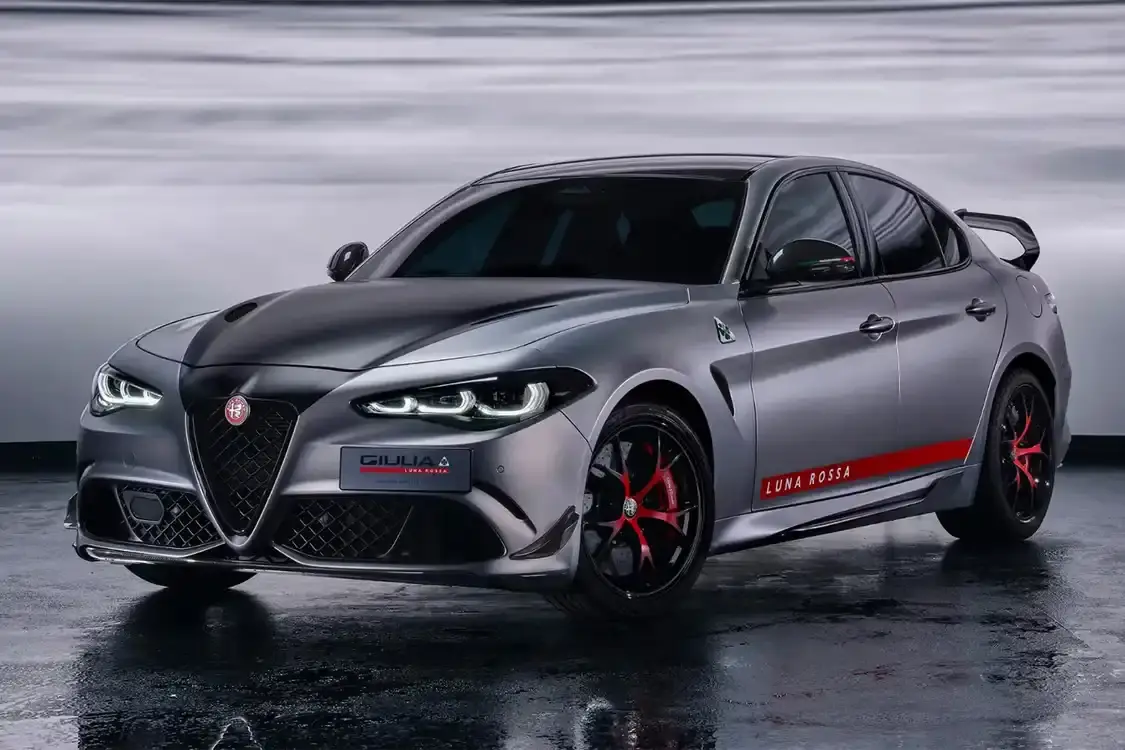
Alfa Romeo displayed the Giulia Quadrifoglio Luna Rossa at the Brussels Motor Show in January 2026. The automaker built ten examples of this special edition, which introduces Bottegafuorisere, a new customization program for low-volume projects. The Luna Rossa edition marks a collaboration between Alfa Romeo and the Luna Rossa Prada Pirelli sailing team, which competes in America's Cup racing.
The Giulia Quadrifoglio Luna Rossa uses a modified version of the standard 2.9-liter twin-turbocharged V6 engine. Power output reaches approximately 520 horsepower, up from the base Quadrifoglio's 505 hp. The drivetrain includes a mechanical limited-slip differential. Alfa Romeo fitted an Akrapovič exhaust system that increases sound output during acceleration and high-rpm operation.
Aerodynamics separate this edition from the standard Quadrifoglio. Alfa Romeo added carbon fiber components throughout the exterior. The front end receives canards that direct airflow around the wheels. Side skirts run along the lower body panels. The rear features a two-tier wing design that takes inspiration from the foils on Luna Rossa's AC75 racing yacht. Engineers revised the underbody to improve airflow beneath the chassis. These modifications produce approximately 140 kilograms of downforce at 300 kilometers per hour, five times more than the standard Quadrifoglio generates at the same speed. The aerodynamic changes do not reduce the top speed.
The exterior finish uses a hand-applied iridescent grey paint. A contrasting black treatment covers the hood, roof, and rear section. A red stripe runs along the sides, accompanied by Luna Rossa branding. Alfa Romeo placed its badges on a red background for the first time in the company's production history. The 19-inch wheels feature a gradient finish that transitions from grey at the center to red at the outer edge.
Interior modifications include Sparco racing seats upholstered in materials that reference the personal flotation devices worn by Luna Rossa crew members during races. The dashboard incorporates a thin section of sail material from an actual Luna Rossa racing yacht. This insert sits beneath a transparent layer and provides a direct connection to the sailing program.
Production took place at Alfa Romeo's Cassino facility in Italy. Specialist craftsmen completed final assembly and finishing work. The ten-unit production run sold out before Alfa Romeo released official images to media outlets.
The Bottegafuorisere program follows a trend among Stellantis brands to offer low-volume, high-specification variants of existing models. These projects target collectors and enthusiasts willing to pay premiums for exclusivity and specialized modifications. The Luna Rossa edition demonstrates how automakers extend product lifecycles through limited collaborations and special editions, particularly as internal combustion engines face regulatory pressure in European markets.
Alfa Romeo positioned the Luna Rossa edition as a celebration of Italian engineering and design traditions. The sailing partnership connects automotive and maritime racing disciplines, both of which emphasize lightweight materials, aerodynamics, and performance optimization. The AC75 yacht class uses hydrofoils to lift the hull above water at speed, reducing drag. This technology influenced the design of the Giulia's rear wing profile.
The Brussels Motor Show appearance places the Luna Rossa edition in front of European automotive media and potential clients for future Bottegafuorisere projects. Alfa Romeo has not announced whether the customization program will expand to other models in the lineup or if additional collaborations will follow.
The Giulia Quadrifoglio platform launched in 2016. The rear-wheel-drive sedan competes with German rivals including the BMW M3 and Mercedes-AMG C63. Sales volumes for the Quadrifoglio variant remain modest compared to mainstream Giulia models, but the nameplate maintains significance for brand image and motorsport heritage connections.
Alessio Forghieri
Editor with a degree in Mechanical Engineering from the "Enzo Ferrari" University of Modena. Writing about cars allows me to combine my technical knowledge with my lifelong passion for automobiles. I love exploring and sharing stories about design, performance, and innovation that make every car unique.
Share this article
RELATED


ITALIAN STATE POLICE RECEIVE 907-HP LAMBORGHINI

LEWIS HAMILTON DRIVES FERRARI F40 TO MONZA

ASTON MARTIN VALEN 838 HP V12 DEBUTS

GORDON MURRAY S1 REVIVES PURE V12 MANUAL DRIVING
