
Summary:
Summary:
- Arte Fiera and Fondazione Furla continue their performance program with French artist Chalisée Naamani in February 2026
- Naamani works across painting, sculpture, fashion, and technology, creating what she calls "image clothing"
- The performance takes place at Padiglione de l'Esprit Nouveau, a 1977 reproduction of Le Corbusier's 1925 Paris pavilion
- Wardrobe transforms the space into a large closet where Naamani performs the act of ironing
- The work features monochrome garment covers made of tweed suspended on dry cleaning rails
Arte Fiera extends its partnership with Fondazione Furla for another year of live performance programming. Bruna Roccasalva, the foundation's artistic director, curates the series. For 2026, French artist Chalisée Naamani joins a roster that previously included Public Movement in 2023, Daniela Ortiz in 2024, and Adelaide Cioni in 2025.
The fair runs from February 6 to 8, 2026, with a preview on February 5. All programming takes place at Padiglione de l'Esprit Nouveau in Bologna.
Naamani was born in 1995 in Neuilly-sur-Seine, France. She trained at the École Nationale Supérieure des Beaux-Arts in Paris, where she continues to live and work. Her practice spans multiple disciplines. She uses painting, sculpture, fashion, and technology as starting points for her work.
The artist examines how visual identity forms around the contemporary body. She looks at representation systems in mainstream culture through both art historical references and personal narrative. Her process involves assembling recycled materials and printed fabrics. These fabrics carry images from an archive she builds over time. She refers to these pieces as vêtements-images, or "image clothing". These garments function as paintings or sculptures. They exist as objects, not as wearable pieces.
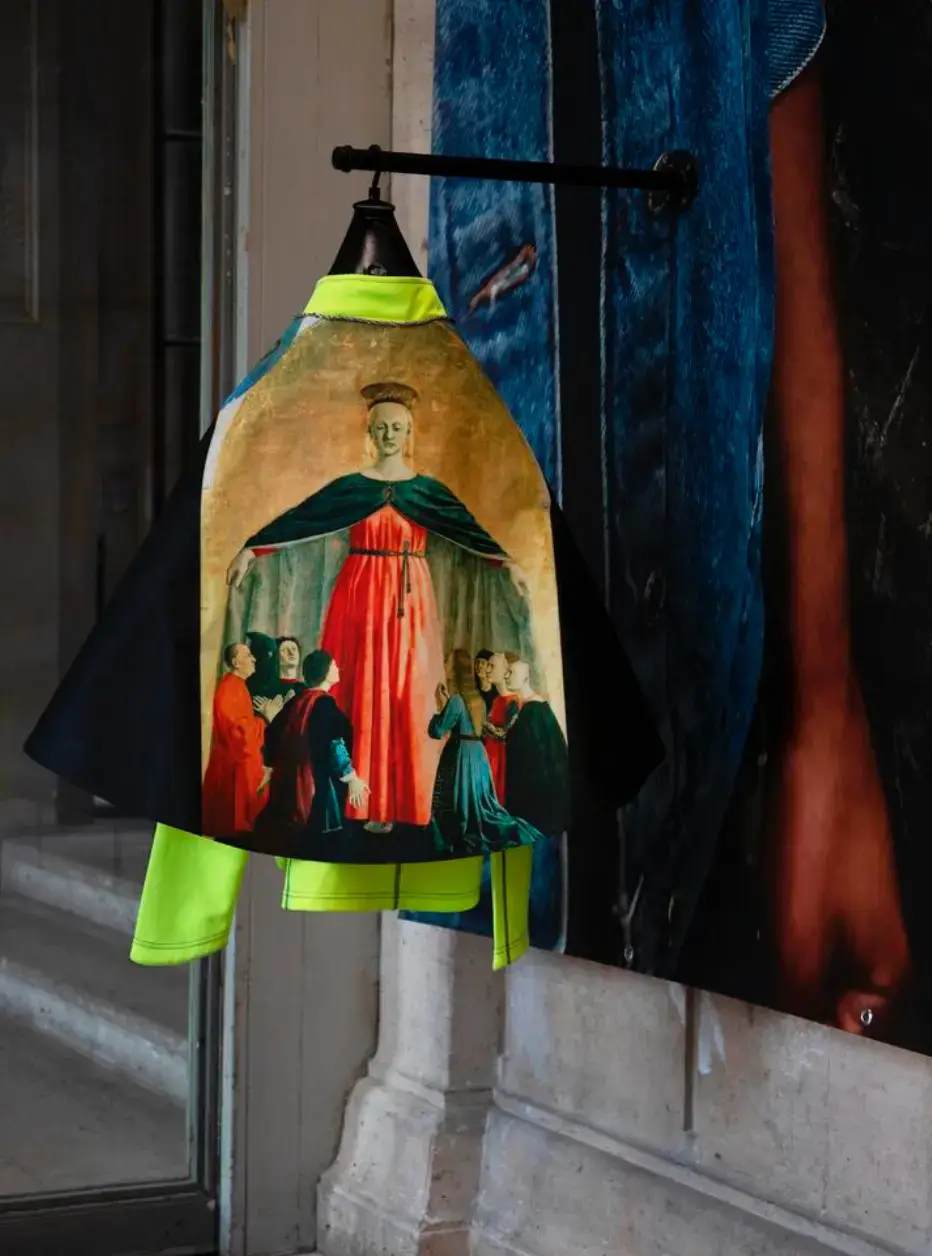
For Arte Fiera, Naamani presents Wardrobe, a new work combining performance, sculpture, and installation. The piece responds directly to the Padiglione de l'Esprit Nouveau and its double nature as both modernist manifesto and prototype of Le Corbusier's machine à habiter.
The venue holds historical significance. The pavilion sits at Piazza della Costituzione 11 in Bologna. Workers built the structure in 1977 as a faithful reproduction of an original design by Le Corbusier and Pierre Jeanneret. The architects created the first version for the 1925 Exposition Internationale des Arts Décoratifs in Paris.
Naamani transforms the pavilion into a large wardrobe. The word wardrobe derives from the French garde-robe, meaning both "to keep" and "garment". The installation explores concepts of clothing, dwelling, and habit. The work examines how the body, its shelter, and repeated gestures construct ways of being.
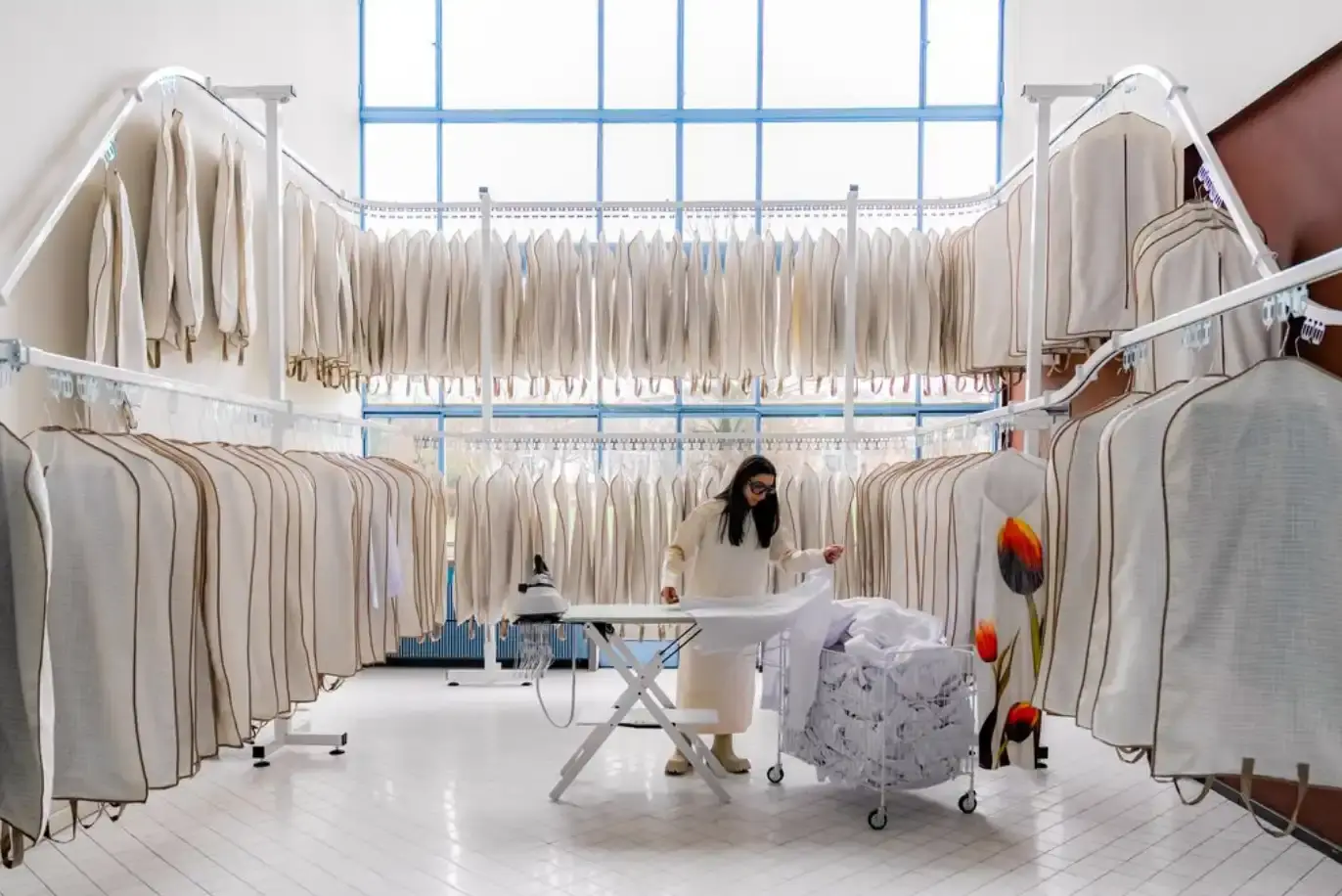
A rail system typically used in dry cleaning businesses runs through the pavilion. The rail traces a line through the space, engaging with the building's pure geometries. The line ends in a room where numerous monochrome garment covers hang in identical, orderly rows. These covers frame the performance action.
For the first time, Naamani's colorful garments give way to their protective coverings. If clothing already acts as an interface, a second skin, and an archive of the body, the garment cover emphasizes ideas of custody, protection, and containment. The cover becomes a meeting point between architecture and the body.
The fabrics shift from Naamani's typical eccentric textiles. The work strips away iconographic elements. Materiality, texture, and the weave of tweed replace the narrative networks built by images. The surfaces appear neutral but carry weight.
Tweed transmits neutrality through its reduced color palette and absence of images. The material holds deep historical and social references. Class, tradition, durability, and protection all link to this fabric. Tweed was designed to protect against cold and wind, to last over time. The fabric resonates with notions of coverage, shelter, conservation, and care running through the entire project.
The choice of tweed functions symbolically rather than decoratively. The material embodies the idea of protecting the body and, by extension, safeguarding memory and identity. Western culture associates tweed with respectability, normativity, and social stability. Coco Chanel made the fabric an icon of emancipation and refinement. Within a context where the body remains absent, covered, or held at distance, this creates a dissonance opening critical readings of protection, visibility, and control.
In Naamani's work, meanings layer and split. The installation opens to readings resonating with current events in Iran, her country of origin. Under present repression, these garment covers take on unexpected echoes. They evoke protected bodies and surface images belonging to our present. Their whiteness reads as a silent gesture of commemoration and tribute. Facing a heavily armed government, protesters stand literally unarmed. The body represents the last line of defense. Resistance stops being symbolic and becomes a matter of survival. After years of silence, the body becomes the final shield.
A dress with printed tulips appears among the numerous covers. This holds specific meaning tied to Iran, where the red tulip symbolizes martyrdom, often associated with those who fell for freedom.
At the center of this space, Naamani performs the act of ironing. The daily gesture evokes care and dedication but also mechanical repetition and alienation. References to this iconography run through pop culture and art history, from seventeenth-century Flemish and Dutch painting to Edgar Degas and Pablo Picasso's celebrated ironers, through to feminist performance actions of the 1970s and 1980s.
Placed within the Padiglione de l'Esprit Nouveau, this gesture connects directly to Le Corbusier's vision of the house as machine à habiter, a rational and efficient organism designed to meet daily life needs.
In its mechanical repetition, the act of ironing reflects the same idea of functionality embodied by modernist architecture. If the house functions as a machine, the body becomes an integral part, inserted into a system where every element operates in synergy. At the same time, this action involving care, attention, and dedication highlights the corporeal and affective dimension of dwelling. The work reveals how every functional space gets crossed by daily practices redefinining its meaning.
In the subtle gap between functionality and affectivity, Wardrobe opens space for reflection on dwelling and the dynamics regulating the relationship between body and architecture. Through a simple, repeated gesture, Naamani uses domestic action as a critical device, highlighting the ways the body inserts itself, adapts, and renegotiates the spatial and functional systems of daily dwelling.
Naamani's exhibition history includes both gallery and institutional shows. She had a solo presentation at Palais de Tokyo in Paris in 2025. She showed at Pinacoteca Agnelli in Turin in 2024. Earlier solo exhibitions took place at La Galerie in Noisy-le-Sec in 2021 and at Art-O-Rama in Marseille the same year.
Her group exhibition record spans multiple European venues. These include Hangar Y in Meudon in 2024, Nice Biennal in 2022, Poush in Paris in 2022, Reiffers Institute in Paris in 2022, La Villette in Paris in 2022, and BOZAR in Brussels in 2022.
Awards mark her career trajectory. Pinacoteca Agnelli gave her the Pista 500 Award in 2023. She received the Prix des Fondations for sculpture and installation in 2021. The same year brought the Prix Benoît Doche de Laquintane.
The collaboration between Arte Fiera and Fondazione Furla demonstrates an ongoing commitment to performance as a format within the fair structure. Each year brings a different artist to the pavilion space. The program situates contemporary performance work within a context referencing early modernist architecture and design principles.
Naamani's approach to materials and her interest in the intersection of fashion, art, and identity align with discussions about how bodies and images relate in digital and physical spaces. Her work enters a conversation about representation extending beyond traditional art contexts into broader cultural production.
Performance Schedule:
Thursday, February 5: 4pm and 6pm
Friday, February 6: 12pm and 6pm
Saturday, February 7: 12pm, 4pm, and 6pm
Sunday, February 8: 12pm and 3pm
Each performance lasts approximately 75 to 90 minutes. Entry to the pavilion remains free without reservation. Visitors do not need an Arte Fiera ticket to access the performance. The fair's daily ticket allows one entry only, with no re-entry permitted.
Padiglione de l'Esprit Nouveau Opening Hours:
Thursday, February 5: 3pm to 8pm
Friday, February 6: 11am to 8pm
Saturday, February 7: 11am to 8pm
Sunday, February 8: 11am to 6pm
The February dates place the fair early in the European art calendar. Bologna's central location in Italy makes the city accessible for both Italian and international visitors. The fair structure allows for viewing both commercial gallery presentations and the performance program in one visit.
++
Chalisée Naamani, Wardrobe , Padiglione de l'Esprit Nouveau , Bologna, 2026. A project by Arte Fiera in collaboration with Fondazione Furla. Courtesy the artist and Ciaccia Levi (Paris - Milan). Ph credits Team99.
Andrea Darren
Born in Manchester, from a young age, she was passionate about art and design. She studied at the University of the Arts in London, where she developed her skills in these fields. Today, Andrea works as an editor for a renowned publishing house, combining her love for art and design with her editorial expertise.
Share this article
RELATED


JIL SANDER AND THONET FURNITURE COLLECTION

MR STAR CITY ON TURNING PERSONAL EXPERIENCE INTO POWERFUL ART

WILDSIDE YOHJI YAMAMOTO BLACK BAMBOO CHAIR
