Summary:
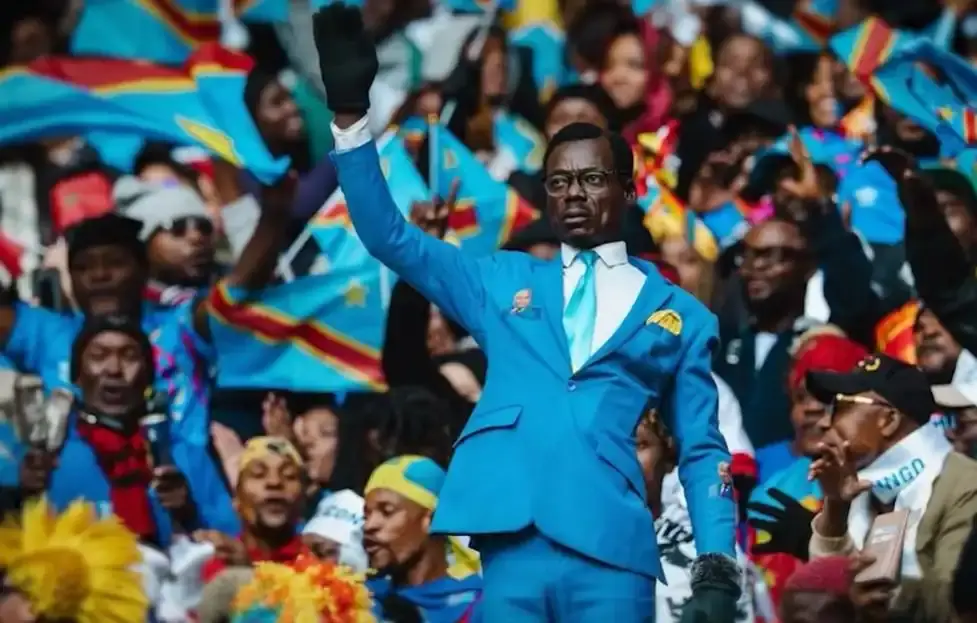
- Michel Kuka Mboladinga stood motionless throughout RD Congo's matches at the 2025 Africa Cup of Nations, arm raised, honoring Patrice Lumumba
- His pose replicates statues of Lumumba, Congo's first prime minister assassinated in 1961 after speaking against Belgian colonial rule
- The gesture lasted 438 minutes across multiple games before Congo's elimination, drawing international attention and transforming stadium stands into living memorial
RD Congo Fan Stands Through Entire Tournament
Michel Kuka Mboladinga arrived at the Africa Cup of Nations with a mission far removed from typical fan behavior. He wore a suit echoing the colors of the Democratic Republic of Congo's flag. He took his position in the stands. Then he stopped moving.
Throughout each match, Mboladinga remained standing, right arm extended toward the sky. He held this position from kickoff to final whistle. Goals scored. Goals conceded. He never flinched. The cameras found him repeatedly. Social media accounts shared his image thousands of times. What appeared to casual observers as spectacle or performance art carried deeper historical weight.
The pose honors Patrice Lumumba, Congo's first prime minister after independence. On June 30, 1960, Lumumba delivered a speech at the independence ceremony that shocked Belgian officials present. King Baudouin had just finished praising colonial rule. Lumumba responded by cataloging decades of exploitation, forced labor, and racial violence. He spoke truths the Belgian government wanted buried.
Seven months later, Lumumba was dead. A coup backed by Western intelligence services removed him from power in September 1960. Soldiers executed him in January 1961 alongside Maurice Mpolo and Joseph Okito. Lumumba was 35 years old. His captors dissolved his body in acid. For decades, his family had no remains to bury. Only in recent years did Belgium acknowledge that a police officer had kept one of Lumumba's teeth as a trophy.
Mboladinga's stance replicates the posture seen in statues and official portraits of Lumumba across Congo. The raised arm. The upward gaze. The unmoving determination. By holding this position through 438 minutes of football, Mboladinga transformed himself into a living monument.
Spectators noticed him immediately. Journalists sought interviews. CAF president Patrice Motsepe invited him for a meeting. What began as personal tribute became one of the tournament's defining images. The gesture transcended sport, connecting present-day national pride with historical memory.
Congo's campaign ended yesterday in the round of 16. Algeria won 1-0 after extra time. Following the goal, Algerian player Mohammed Amoura mimicked Mboladinga's statue pose in what appeared to be mockery. The celebration drew immediate criticism from across the football world. Fans, journalists, and fellow athletes condemned the gesture as disrespectful. Social media erupted with denunciations. Critics pointed out that Amoura had mocked not just a fan, but a tribute to a murdered leader and a nation's painful history.
The backlash forced Amoura to respond. In the days following the match, he issued a public apology to both Mboladinga and the Democratic Republic of Congo. The incident transformed what might have been a footnote into a defining moment of the tournament, underscoring the significance of Mboladinga's tribute and the reverence it commanded.
When the final whistle blew, Mboladinga finally broke his pose. Tears streamed down his face. The cameras captured this moment too, a private grief made public.
The elimination meant more than a tournament exit. For Mboladinga, each match served as opportunity for commemoration. Each minute standing honored a leader whose vision for African independence cost him his life. Each game allowed him to remind viewers of a history many prefer forgotten.
Belgian authorities returned Lumumba's tooth to his family only in 2022, more than six decades after his murder. The delayed repatriation sparked renewed discussion about colonial crimes and their ongoing legacy. Mboladinga's gesture at the Africa Cup placed this conversation in front of millions of football fans who might never encounter it otherwise.
His presence asked uncomfortable questions. Who gets remembered? Who gets forgotten? Which heroes receive statues and which disappear into unmarked graves? By standing immobile while players ran and crowds cheered, Mboladinga created space for reflection in an environment typically devoted to distraction.
The Republic of Congo plays football matches frequently. Fans wear jerseys, wave flags, and sing anthems. Mboladinga chose different tools for expressing national identity. His suit, his posture, and his stillness communicated messages words alone never could. He demonstrated how memory works as active practice, requiring deliberate effort and physical commitment.
When Algeria's winning goal went in during extra time, Congo's tournament ended. Mboladinga's personal project concluded simultaneously. He had achieved what he set out to do. He had made people look. He had made them ask why. He had connected football fandom with historical consciousness, proving that sports stadiums serve purposes beyond entertainment.
The tears he shed reflected multiple emotions. Disappointment at his team's loss. Exhaustion from days of physical strain. Pride at completing his tribute. Relief that his message reached beyond Congo's borders. His face told stories his statue-like pose had deliberately suppressed.
Soufiene El Boub
was born and raised in France, where he also pursued his education. With a lifelong passion for sports and storytelling, Soufiene has become a sports editor, known for his insightful analysis writing. His unique perspective, shaped by his French upbringing, adds a distinctive flair to his work in the world of sports journalism.
Share this article
RELATED

NEW BALANCE ATALANTA BC 2026/27 THIRD KIT

MBAPPÉ DEBUTS PROTOTYPE ON BOOTS AT REAL MADRID


COMO 1907 RELEASES STICKER COLLECTION

ANTONELLI WINS MONZA GRAND PRIX FROM 19TH PLACE
