
Summary:
- Phil Collins filmed two groups of Palestinian youth dancing for eight hours in Ramallah during the Second Intifada in 2004
- The work uses duration and repetition to reveal the complexity of individual lives under occupation
- The piece contrasts sharply with social media content showing playful violence during the current conflict in Gaza
In March 2004, British artist Phil Collins held auditions in Ramallah. He wanted people willing to participate in his project. He selected two groups of young Palestinians. The first group had three men and one woman. The second had three women and two men. Collins asked them to dance without stopping for an entire day to a sequence of pop songs.
The resulting work, they shoot horses, runs for seven hours across two video channels. The camera stays fixed and frontal. There are no special effects. No narrative develops. The film simply shows the two groups dancing. You see their enthusiasm fade into exhaustion. Power cuts interrupt them. Indirect signs of occupation appear.
The film breaks standard rules of cinema. Its excessive length forces you to confront the persistence of these young Palestinians. You begin to see the complexity of their lives, how they interact with each other, how fatigue builds as their performance continues. All of this happens during the Second Intifada, though the film never states this explicitly. The political weight becomes clear through omission.
Resistance appears as something physical and sustained. The continuous movement of bodies, despite growing tiredness and external disruptions, becomes an act of self-affirmation. The context is occupation and colonial violence. The dancing becomes a form of insistence on existence.
Twenty years after Collins made this work, it has been restored. The timing feels pointed. The Zionist colonization of Palestine appears to be reaching a final stage. Gaza faces genocide. The West Bank confronts annexation. In 2004, Collins' work showed bodies living under occupation. Today those same images sit alongside a landscape where colonial violence has intensified to genocidal scale. The work gains new critical power through this historical perspective.
The format seems familiar now. Young people dancing in front of a camera recalls TikTok content creators. But the similarities end there. Dance videos on TikTok compress choreography into simple, recognizable, replicable gestures. They compete for attention in the space of a scroll. Collins' film extends beyond any reasonable attention span. You must spend time with these images.
The work asks you to stop, to observe, to investigate movements and interactions. The performers reveal their physical traits and personalities. Critic Liz Kotz wrote in her essay Phil Collins: the world won't listen: "We never knew these young people, but after a while we feel we know a lot about them: the slightly cheerleader girl with big earrings and sportswear, the tired girl, the handsome and detached boy. As fatigue takes over, their efforts appear alternately tragic and comic, heroic and heartbreaking."
Collins uses duration and repetition as tools of revelation. TikTok works through dynamics that consume themselves in seconds between scrolls. This distinction becomes disturbing when you compare they shoot horses with TikTok videos published by Israeli occupation forces in Gaza since October 2023. These videos show soldiers joking while committing massacres and devastation.
This is not what Hannah Arendt called "the banality of evil." That concept described barbarism as the result of bureaucratic alienation, of officials lacking critical thought and basic ethical consideration. After October 7, barbarism took a different form. The horror of genocide now includes the playful, almost childlike participation of its executors. Violence loses the taboos that human civilizations usually produce to contain it within certain boundaries. Instead, violence becomes a form of entertainment.
This ferocity exceeds the parameters that post-World War II contemporary culture used to conceptualize the evil that Western civilization generated throughout the last century in Europe and the four centuries before that across the rest of the world. A new aesthetic regime emerges where horror itself becomes consumption and spectacle. Violence reaches a paradox where the brutality of the perpetrator against victims takes on characteristics of cuteness, as Noura Tafeche noted in her article on the era of cute violence.
The comparison reveals a fundamental conflict. On one side, a device that insists on the unpredictability and complexity of bodies. On the other, a machine producing images that reduces bodies to signs of power and elements of horrific spectacle. Fred Moten theorized a Black aesthetic through the notion of fugitivity. He argued that the political force of representation lies in the opacity and excess of bodies, in their irreducibility to predictable narrative or propagandistic functions.
In the tired and excited, hesitant, obstinate and resistant bodies of the young Palestinians in they shoot horses, a critical space opens that opposes any process of dehumanization. What appears is an image of irreducible otherness. By exceeding control devices, it dismantles colonial logic. This excess produces a form of aesthetic insubordination, an implicit refusal to be read as passive victims or bodies available to the colonial gaze.
they shoot horses returns not only the presence of complex subjectivities but also the possibility of thinking about images as sites of resistance. These images can subvert a visual regime dominated by spectacularized violence and the erasure of Palestinian lives.
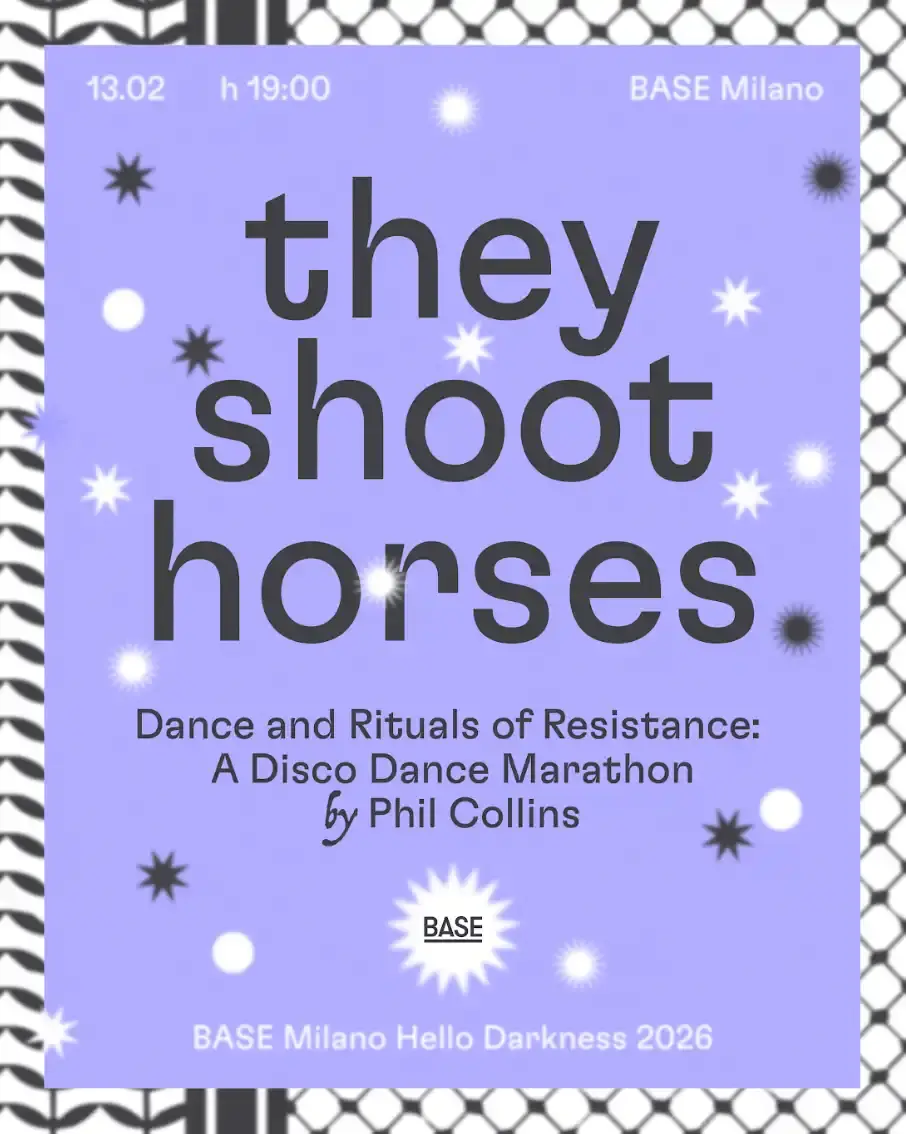
The film screens at BASE Milano on February 13, running from evening into early morning. The format invites participants to join the dance, turning viewing into an act of collective resistance. The eight hours become something to be experienced rather than simply watched.
RSVP your ticket here.
Staff
Casawi Magazine: based in Milan, we celebrate youth culture, creativity, and community across fashion, sports, music, art, design & more.
@casawi.magazineShare this article
RELATED


APPLE OPENS MUSIC VENUE AT BATTERSEA


THERE'S A WOMAN IN YOUR RADIATOR
