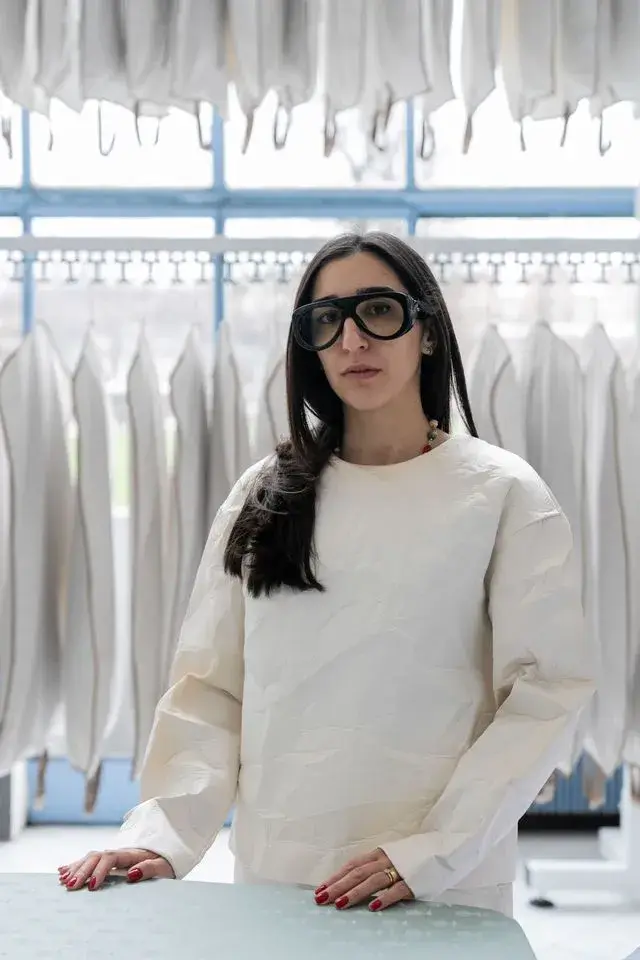
When you explore the work of Chalisée Naamani, you encounter a French-Iranian artist focusing on textile and sculpture. She creates garment-forms blurring the line between clothing, image, and space for your observation. The performance Wardrobe (2026) operates as a project by Arte Fiera in collaboration with Fondazione Furla, curated by Bruna Roccasalva.
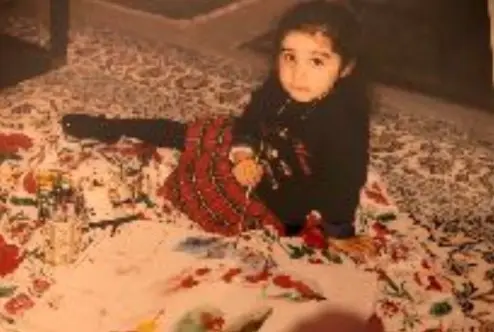
There is a photograph that Chalisée shows us, wishing to express herself through the narrative of her memories, her images: a little girl sitting on a Persian rug, painting on sheets of paper laid over a floral tablecloth, wearing a red plaid skirt that almost disappears amidst the swarm of surrounding patterns. This image seems to be a warning for the artist; indeed, it is almost a manifesto - unconscious, instinctive, precise.
For Chalisée, everything is in dialogue; things speak to each other continuously. Seeing herself lying on the floor, in the first moments of creation, in this silent and unconscious conversation between the things of space, and beyond, the artist manages to connect, in empathy with the world around her, and with her past. She finds herself – repeatedly.
Chalisée Naamani's roots lie between two worlds- France and Iran; They intertwine, holding hands, forming an imagery in which the artistic gesture finds consciousness and the fabric merges with the soul, to the point of sculpting it.
What makes her work unique is the ability to bring together seemingly irreconcilable and incompatible registers: the intimate and the political, the playful and the serious, lightness and weight.
Chalisée, with her artworks, does not choose between these mismatched poles; she inhabits them all together, certain that lightness does not betray complexity, but sometimes transcends it more effectively than clamour.
The fabric, in her work, already carries everything: history, mourning, beauty, resistance. The artist's task is not to add, but to let the surface speak, and to allow it to interact with the others.
Her artworks speak, and have her voice, more than she herself can imagine.
-
If you had to choose an image of you as a child that tells something about your artistic origins, which one would it be and why?
There is a photograph of me sitting on a Persian carpet, painting on sheets of paper placed over a floral tablecloth. I’m wearing a red tartan skirt that almost blends into the patterned surroundings.
Looking at it now, I can already see how I was visually operating — layering motifs, placing one surface over another, creating a kind of instinctive collage. The carpet, the floral fabric, my patterned outfit, and the drawings were all in dialogue.
I wasn’t just painting; I was already composing through superposition. My work still functions that way today — layering inherited patterns, personal gestures, and different visual worlds into one surface.
How do your Franco-Iranian roots interact in your work?
They don’t function as opposites but as parallel narratives. My work exists in the space where these stories encounter and question each other. Both cultures carry complex literary, visual, and intellectual histories. What differs is the perspective they produce in me — different ways of seeing, narrating, and positioning the image. My work develops in that in-between space, where multiple cultural frameworks coexist and continuously reshape one another. That layered condition is the essence of diaspora. My work reflects an identity built from overlapping cultural perspectives rather than a single origin.
How did you experience carpets and fabrics as a child, and how do you see them now?
As a child, carpets were landscapes or playgrounds. As you can see in the photograph, I would draw and paint on them, but I also played with Lego or marbles on their surface. The motifs became part of the game — I used them as borders, or imaginary settings. My father used to tell me they were invented in the desert, when kings traveling without vegetation asked for gardens to be woven for them. That idea stayed with me — textiles as portable paradises. Today, I see them as emotional and political surfaces carrying migration, labor, memory, and survival.
Why visual art instead of fashion?
Fashion operates within cycles — production, consumption, seasons. I felt a different temporality in art. Visual art allowed me more freedom, more hybridity. I could step outside function and propose a sentence, a reflection, rather than a product. It gave me space to question clothing instead of producing it.
Is your work political, intimate, playful?
All three. The intimate is always political. And playfulness allows complex or heavy histories to circulate differently — sometimes more powerfully.
How does a garment come to life?
It often begins with an image, a memory, or a story. Then comes research, drawing, collecting fabrics, and constructing. The final form is always a negotiation between concept and material.
What’s your relationship with social media?
I experience Instagram as something almost baroque — excessive, layered, ornamental. It’s a continuous flow of images, references, and staged identities. That density is what attracts me. It feels like a living mosaic where everything accumulates.
What interests me most is how people curate their profiles. Each account becomes a constructed surface — edited, composed, almost designed like a garment. We shape how we appear, what we reveal, what we archive. In that sense, profiles function like digital textiles: they frame identity.
Compared to platforms like TikTok, I feel there is still slightly more time on Instagram — more space to look, to read, to pause. It’s still fast, but less purely driven by immediacy. That subtle difference in temporality makes it a more contemplative space, even within the constant flux.
At the same time, I’m cautious about social media. There’s a French rapper (Booba) who says, “They wage war with tanks while we post squares on Instagram.” That sentence stays with me. Sometimes complex political realities are reduced to simple symbolic gestures or self-declared activism, and that makes me uneasy. I’m interested in these platforms, but I remain very aware of their limits.
“Octogone” and the figure of your grandfather — why did it become architecture?
The project began with the octagon — the geometric shape of the arena where athletes practice in the zurkhaneh. I was inspired by the architecture and the ritual dimension of varzesh-e pahlavani to construct the exhibition itself. The octagon became both structure and narrative device.
But this shape also resonates beyond that context. Across architectural histories — from ritual spaces to Renaissance baptisteries — the octagon often functions as a transitional form, between square and circle, earth and sky.
Building the exhibition through this geometry allowed memory, sport, and architecture to merge into a space that visitors could physically enter.
“Wardrobe (2026)" and ironing — how did that emerge?
Performance is not my primary medium, so I had to find a way to activate work usually meant to be seen rather than performed. I create garment-sculptures that are made to be looked at, not worn, so translating them into action required a shift in approach.
Invited to work inside the replica of the Pavillon de l’Esprit Nouveau, I couldn’t ignore its ideological weight — the pavilion isn’t neutral.
I started thinking of the space as a machine: both Le Corbusier’s idea of the house as a “machine for living” and a nod to Bologna’s history of houses as sites of labor. I imagined a rail system spanning the space, carrying hundreds of white tweed garment bags.
Ironing became the action. It is a repetitive, domestic gesture — quiet, careful, almost ritual. As the structure filled the space, the hanging bags began to evoke images that are impossible to detach from the present: bodies wrapped in bags amid the mass killings in Iran during the brutal January 2026 crackdown, when security forces used lethal force against protesters and many victims were seen in body bags at morgues.
Ironing became the action. It is a repetitive, domestic gesture — quiet, careful, almost ritual. As the structure filled the space, the hanging bags began to evoke images that are impossible to detach from the present: bodies wrapped in bags amid the mass killings in Iran during the brutal January 2026 crackdown, when security forces used lethal force against protesters and many victims were seen in body bags at morgues.
Teresa Borriello
Journalist
writer and independent journalist, covering people’s interests and issues - or anything worth caring about
@teresaborrielloShare this article


