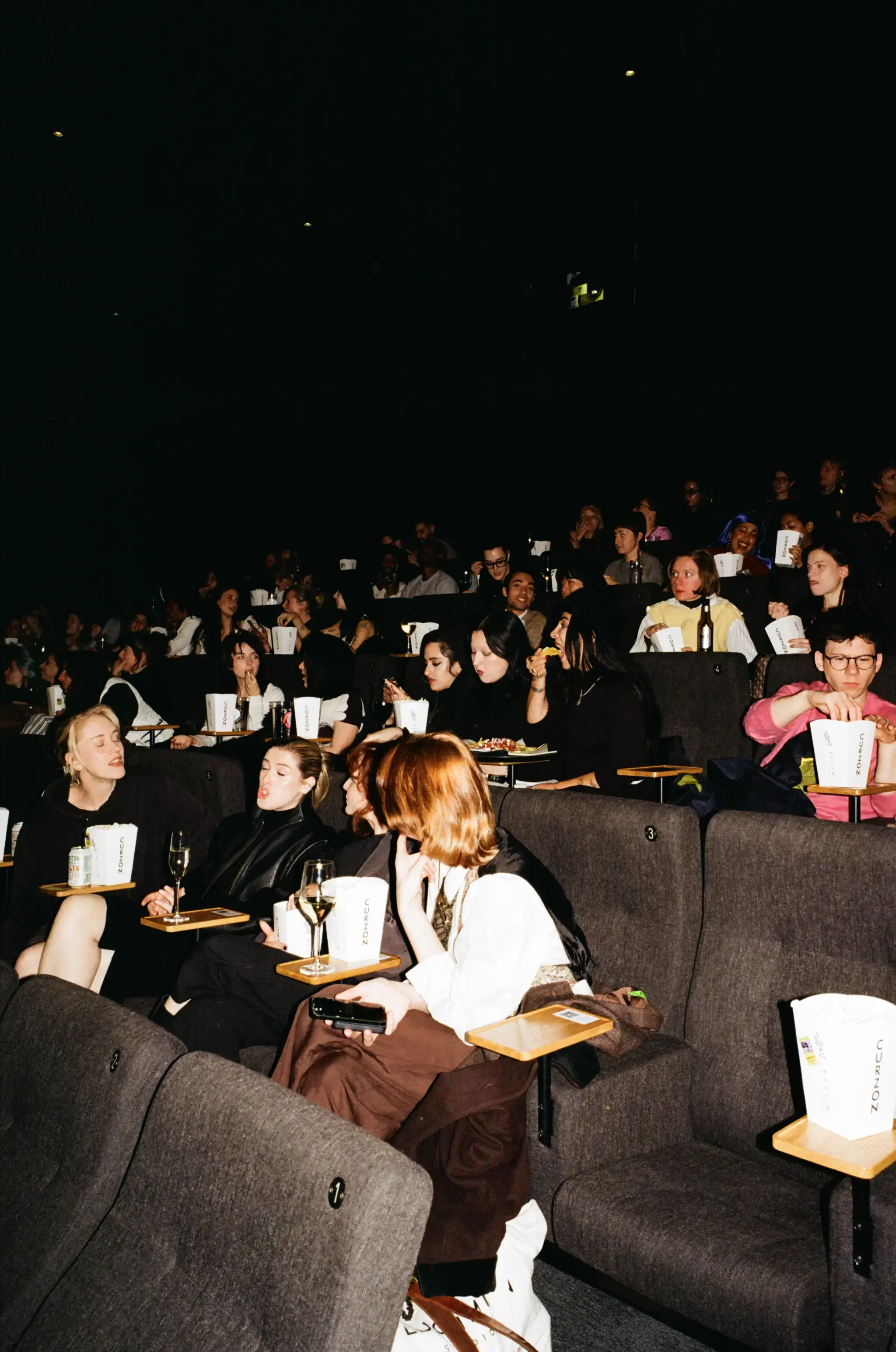
On 12 November, MIISTA brought its London community to Curzon Hoxton for a screening of TEKNOLUST (2002), followed by a panel discussion, in collaboration with Zodiac Film Club. Run by Sarah and Bella, Zodiac Film Club curates film events and writes a monthly newsletter about good-looking films, excess feelings and complex female characters, with a programme that follows their own interests rather than trends.
The brand saw a natural link between the film and its AW26 collection, which explores the many identities we hold within ourselves: how we can feel like different people depending on the day, the hour or the situation, and how clothes become one of the ways we express those different sides.
TEKNOLUST, Lynn Hershman Leeson’s feminist sci-fi
Introducing the film and its director, Sarah and Bella joked: “We now know that you’re not a great filmmaker unless you’ve been booed at a film festival.” Artist and filmmaker Lynn Hershman Leeson has spent her career working on AI, surveillance, digital identities and sexual politics, taking creative risks while being ignored, misunderstood and, at times, booed.
TEKNOLUST is an optimistic feminist sci-fi, or “Sci-true”, as Hershman Leeson describes it, about loneliness, AI and what makes us human. Tilda Swinton plays four roles: Rosetta Stone, a bio-geneticist who uses her own DNA to create three Self-Replicating Automatons, part human and part computer, called Ruby, Olive and Marinne. To stay alive they need organic material, specifically semen, which Ruby collects from unsuspecting men and brews into tea. As the clones leave the laboratory to explore the world, each one develops her own personality, desires and sense of style.
For MIISTA, the film is both a prescient take on our technological present and a funny one. It looks at our multiplicities, the wish to be different versions of ourselves, as a chance to grow and reinvent rather than a risk of losing ourselves.
Identity, technology and desire: the panel
After the screening, Sarah and Bella were joined by Bunny Kinney, Global Executive Creative Director of Dazed Media, artist and writer Ella Fleck, and essayist, film critic and culture journalist Haaniyah Awale Angus.
Ella Fleck read the film as an allegory of how we divide ourselves into more presentable versions online. Bunny Kinney related to Rosetta Stone’s “fantasy of wishing you could be other things or wishing that there were versions of yourself”, while Haaniyah Awale Angus spoke about the need to “dissect yourself” and take on multiple identities, especially as a writer.
On technology and desire, Bella noted that TEKNOLUST predicted the “hot online versions of ourselves” we create to attract partners, but not the deadening of desire that came with them, “the everyone is beautiful no one is horny effect”. Kinney described dating apps as an “illusion of infinite choice” that turns people into engineered, two-dimensional profiles, where the search for intimacy becomes a search for validation. Awale Angus questioned a culture driven by dominance, money and being the best, rather than pleasure in the journey. Fleck summed up the tension by calling desire “a messy kind of, like, animalistic thing”, in an online world built around optimisation and gamification.
More than twenty years after its release, that is what makes TEKNOLUST feel relevant: in a culture focused on how we present, perform and optimise ourselves, it values being multiple, contradictory, messy and entirely our own.
Kristin Kaye
Fashion Editor
Insatiably curious about human expression, she immerses herself in literature, theater, art, and dance. Her academic journey led to degrees in Modern Literature, where she delved into The Furioso, and Historical Sciences with a focus on Contemporary History. Her studies took her to the prestigious Erasmus University Rotterdam, broadening her international perspective.
Her passion for culture isn't confined to personal enjoyment—it spills onto the pages of various publications. There, she explores not only artistic endeavors but also civil rights issues and the myriad ways human culture manifests itself. For her, writing about these topics isn't just a profession; it's an irresistible calling that stems from her deep-seated fascination with the human experience.
Share this article