
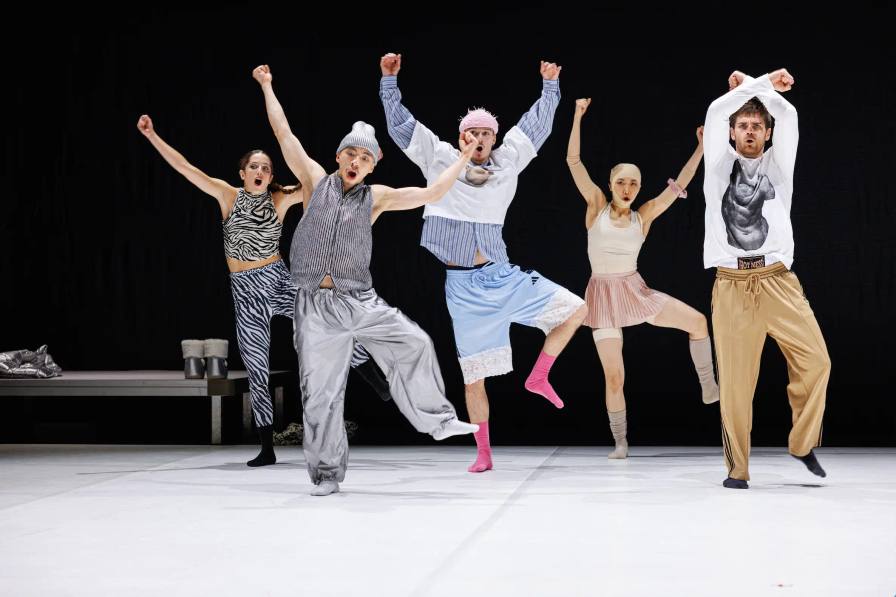
Maria Chiara and Alexander formed Miller de Nobili to merge breakdance with contemporary dance theatre, blending their distinct backgrounds to construct a fresh approach to physical performance. You will observe a specific raw energy in their choreography when watching their shows, as the duo anchors their work in the digital overload defining modern daily routines. Their newest production, Hype the Pain, explores internet humor and online ironies through intense physical movement, transforming the stage into a physical manifestation of an endless social media feed designed to retain your attention. Read the full conversation below to understand their creative methods, see the way they translate memes into dance, and learn about their upcoming projects.
You can also find their website here.
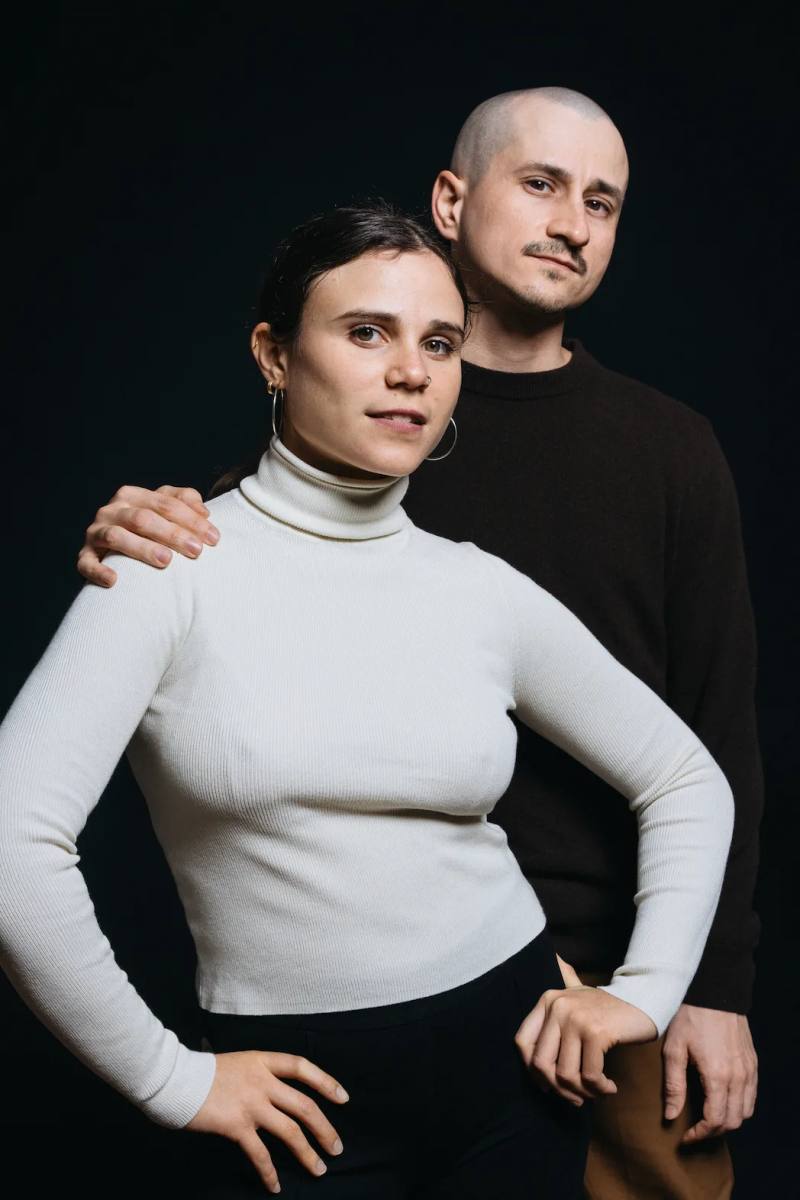
Maria Chiara brings a background in classical and contemporary dance while Alexander comes from breakdance. How did the two of you decide to merge these different disciplines to form Miller de Nobili?
It actually happened very unexpectedly during Covid. Since we were already a couple, we were the only two people allowed to work together in the studio. We started sharing our different movement languages and became increasingly curious about each other’s way of creating. At some point we decided to make a duet together, simply because it was fun. At first, dancing together was a nightmare. Because we were both performing, we couldn’t step outside and see the work objectively. We constantly argued because we both had too many ideas and wanted to shape every detail ourselves.
Over time, we realised that we worked much better as artistic directors than as co-performers. Watching from the outside allowed us to give each other the freedom to experiment, challenge one another and ultimately focus on finding the strongest idea rather than defending our own. That shift completely changed the way we collaborate. That very first project unexpectedly won us the Scapino Ballet Production Prize, which led to our first commission for Scapino Ballet Rotterdam - one of the leading contemporary dance companies in the Netherlands. That experience made us realise that our collaboration had real potential. We've been creating together ever since.
Your work blends street culture with high art theater. Can you walk us through the process of bringing authentic urban energy to a contemporary stage?
From the very beginning of Alex’s choreographic career, breaking was never just a competitive dance form. He was fascinated by its theatrical potential and wanted to explore how its raw energy, musicality and physical intelligence could exist within a theatrical context without losing what makes it unique. When we started working together, that vision naturally expanded through Chiara’s background in contemporary dance and theatre. Together, we developed a choreographic language built around creating a space where different artistic languages can coexist, influence one another and become something new. Street dance culture has always been rooted in community, individuality and dialogue. Those values shape not only the movement vocabulary in our work but also the way we create together in the studio. Working with street dancers is not always straightforward. Many have little or no experience with dance theatre, so part of the process is discovering together what creating for the stage means - both artistically and organisationally. At the same time, contemporary dancers are challenged to rethink their own habits and ways of working. That exchange is where the most exciting moments happen. We often create with casts that combine street and contemporary dancers, and it’s always beautiful to see how they begin to learn from one another. Our rehearsals are highly collaborative. We discuss the themes extensively, experiment with movement, text and improvisation, and invite every performer to contribute their own perspective. Rather than asking everyone to fit into one aesthetic, we try to preserve each individual’s artistic voice. Over time, those different languages begin to merge so naturally that it becomes impossible to tell where one ends and another begins. For us, that’s where the most exciting work emerges.
You two are pushing the boundaries of modern performance. What drives your vision and motivates you to challenge traditional dance formats today?
Our vision is driven by the belief that there are still very few companies in Germany working at the intersection of hip-hop culture, contemporary dance and theatre in the way we do. For us, these forms don’t belong to separate worlds - they enrich one another and allow us to explore the contradictions of contemporary life. We’re interested in creating work that is visually powerful and physically engaging while speaking about the social, cultural and political questions shaping the world we live in today. We believe that audiences shouldn’t have to choose between being entertained and being challenged. A strong artistic experience can do both. We don’t believe audiences need less complexity. They simply need enough entry points to engage with it. That’s why we look for clear theatrical images and themes that resonate beyond the theatre community, without relying on unnecessary abstraction. If someone leaves our performance excited by the dance but also questioning their own perspective, we’ve achieved what we set out to do.
Hype the Pain is your newest production. What is the core concept behind the show, and what exact message do you want the audience to receive?
Hype the Pain is intentionally layered, so reducing it to a single concept or message inevitably leaves something out. At its core, however, the piece explores meme culture and the meanings hidden behind the seemingly harmless images we scroll past every day. Memes can make us laugh, but they can also carry propaganda, racism, body shaming or political activism. What fascinated us is the idea of cultural osmosis: the way repeated images, jokes and messages gradually influence our beliefs and behaviour without us even noticing. This idea also became the dramaturgical principle of the performance. Just as we can scroll from a racist post to a funny cat video, from a war to an advertisement, or from tragedy to comedy within seconds, the piece constantly shifts between contrasting emotions and situations, mirroring the fragmented way we consume information online. Through Hype the Pain, we wanted to make that invisible process visible and ask what happens when the digital world slowly becomes our reality. Alongside this, the piece explores the pressure created by social media to constantly be faster, more successful, more attractive and more visible than everyone else. On stage, that becomes a relentless fight for attention in which recognition is always temporary. Rather than offering answers, we want audiences to leave asking themselves: are we shaping the digital world - or is it shaping us?
The performance tackles internet humor and meme culture. What methods did you apply to turn digital noise and online irony into physical choreography?
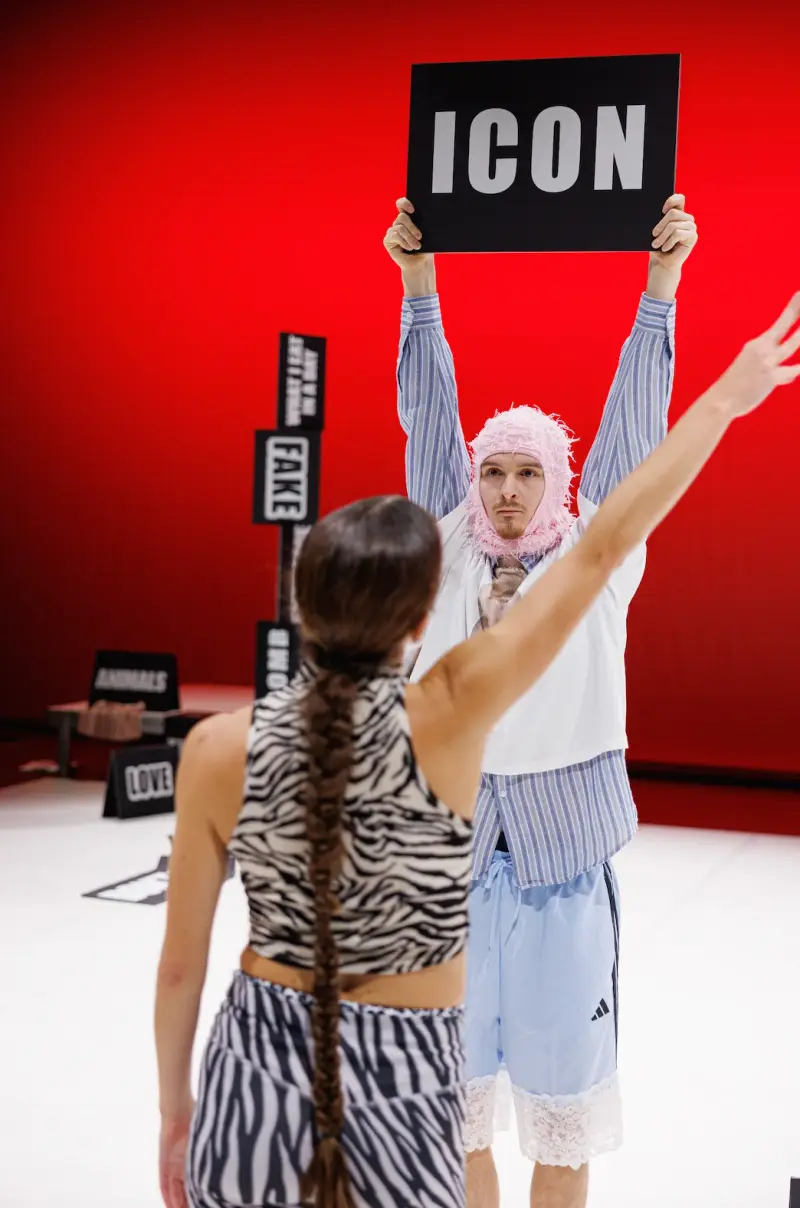
To translate digital culture into choreography, we first spent almost a year collecting memes. We created a shared Instagram group where we continuously sent each other images, videos and trends that caught our attention. These became the starting point for our research. Many movements were created directly from the memes themselves. John Travolta’s iconic Pulp Fiction meme became a dance phrase, while Leonardo DiCaprio’s pointing with a champagne glass became a recognisable gesture, always enriched by the facial expressions and fragmented voices that accompany online content. We also created exaggerated theatrical characters inspired by the polarising personalities that dominate online spaces. Through improvisation, we explored figures such as a racist influencer, a narcissistic pop star or an overconfident boxing champion embodying toxic masculinity. Rather than judging these characters, we were interested in exposing the behaviours and ideologies hidden behind carefully constructed online identities. Their constant fight for attention became one of the driving forces of the performance. Finally, we introduced thirty cardboard signs printed with words from internet culture. Throughout the performance they are combined almost randomly, allowing audiences to make their own connections. What fascinated us was that even arbitrary combinations kept producing new and often unsettling meanings. Just like online, disconnected fragments suddenly appear coherent, whether they actually are or not.
Fragmented voices and dissonant movements reflect information overload in the show. What is your approach to the sound design and the way the audio interacts with the dancers?
For Hype the Pain, we worked closely with our composer Gábor Halász from the very beginning of the creative process. In our first meetings, we defined the musical world of the piece together - a space somewhere between a fashion catwalk, a meme-inspired spectacle and a boxing ring. Techno felt like the perfect language for that world, with its driving rhythms and relentless energy reflecting the speed, pressure and competitiveness of digital culture. Gábor developed the first musical sketches in his studio, giving us a shared sonic direction from the outset. Once the overall structure of the performance had taken shape, the real dialogue between choreography and sound began. Gábor regularly joined us in the studio, where movement, voices and music constantly influenced one another. Sometimes he adapted the existing tracks in response to the choreography or the vocal scores we had created. At other times, a scene felt choreographically too flat, so he expanded the music first, inspiring us to rethink and redevelop the movement. Rather than one discipline serving the other, the choreography and the composition evolved through a continuous back-and-forth. For us, the music becomes another performer in the piece. It pushes the dancers forward, creates tension, leaves space for fragmented voices and occasionally overwhelms the stage altogether. Together, movement and sound create an immersive experience that mirrors the constant stimulation and emotional intensity of life online.
Digital culture shifts daily. What is your strategy to keep a show about the internet relevant, and what are your plans for upcoming projects?
It’s true - digital culture evolves faster than we can think. Even during the year we spent creating Hype the Pain, memes disappeared, new trends emerged and references quickly became outdated. At first, we tried leaving space in the performance to continuously update certain scenes, but we soon realised that chasing the internet is impossible. What remains relevant, however, is not the meme itself but what it reveals. Even if audiences no longer recognise every reference, they will still recognise how digital culture continues to shape the way we think, behave and interact online. More recently, we created another production, our first work for young audiences, exploring the challenges and contradictions of growing up today. Through that project, we rediscovered how important it is to create for younger generations. They are not only the future of our society but also, hopefully, the future of theatre audiences. Looking ahead, we are currently preparing our next full-length creation, No Risk, No Future, which will premiere on 29 April 2027 at HELLERAU - European Centre for the Arts. Without revealing too much, the piece explores what it means to take risks in a world increasingly shaped by uncertainty. We are in the middle of the audition process and are excited to begin this new chapter.
Lorenzo de' Nobili
Music Editor
Lorenzo de’ Nobili is a sound designer and composer driven by a deep passion for urban culture and its evolving aesthetics. His work explores the intersection of music, fashion and sport, blending contemporary sounds with strong visual identities. Alongside his research in urban culture, he collaborates with contemporary dance artists, creating immersive sonic experiences that connect movement, space and emotion.
@sereno________________________Share this editorial
RELATED


THERE'S A WOMAN IN YOUR RADIATOR


WHAT DOES PROSECCO HAVE TO DO WITH THE ODYSSEY?

