
Dede Lovelace was born and raised in Brooklyn, and she is a skater, actress, visual artist and DJ. She is part of the Skate Kitchen collective, and she played Janay in the film Skate Kitchen (2018) and in the HBO series Betty (2020-2021). As a DJ she has played for brands such as Christian Louboutin.
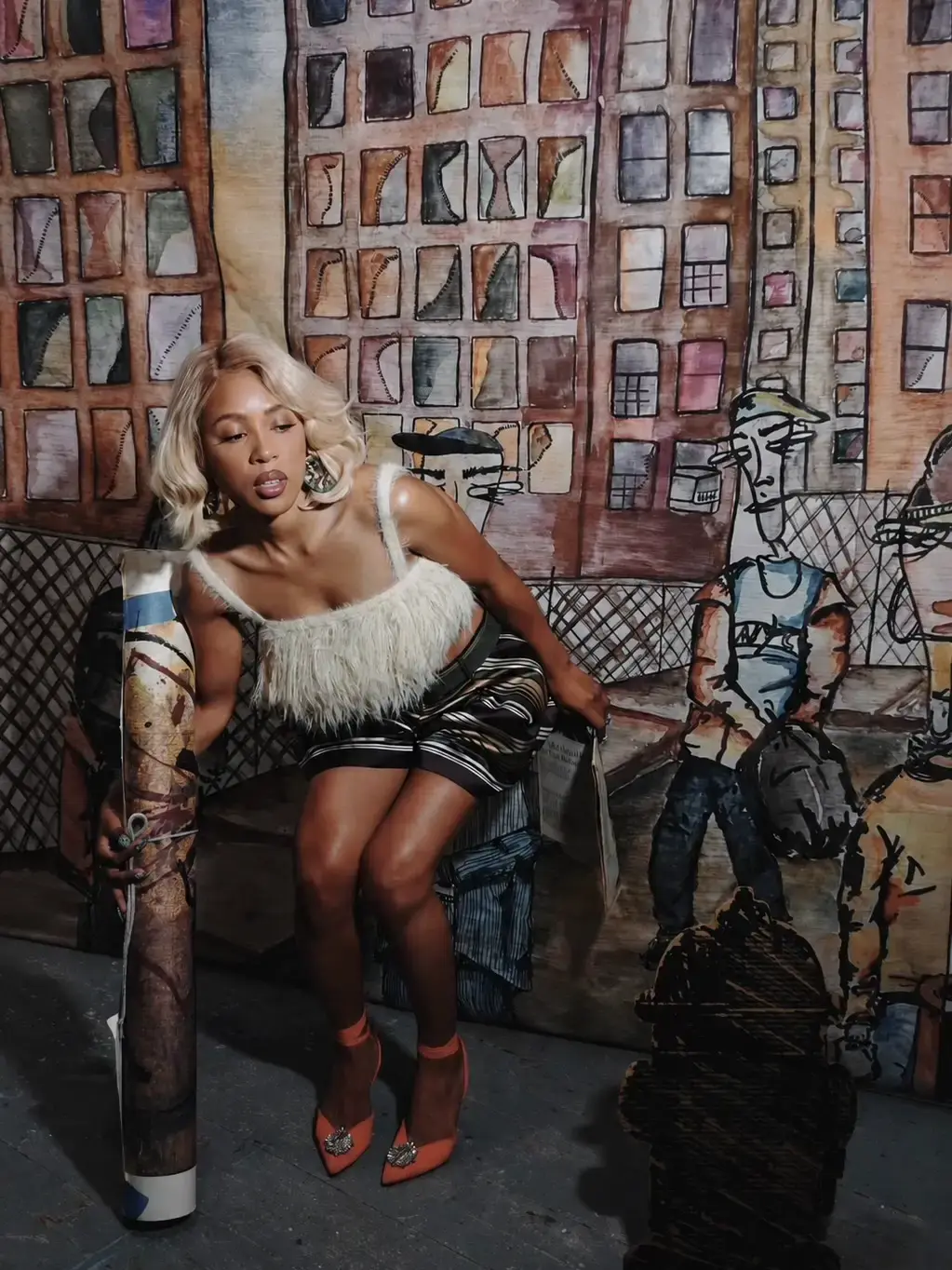
On 17 September 2026 she released BAMBOO, her first single, featuring Dai Burger, a track that brings together litefeet and house. It is part of her project You Are Invited to My Universe, shot in three chapters: the skatepark beneath the Manhattan Bridge in Chinatown, her home studio, and a third chapter inspired by artist-led worlds such as Saint Heron and Heaven by Marc Jacobs. In this Dede Lovelace interview, she talks about the skatepark, painting, litefeet and what she is building next.
Dede Lovelace on the skatepark, painting and BAMBOO
Your shoot for this project goes back to the skatepark beneath the Manhattan Bridge in Chinatown. What did that place teach you that you still use in your work today?
Dede Lovelace: It taught me how to hold my own around men, it can be rough navigating male dominated spaces. A lot of times men question if women are even capable of keeping up or getting a job done. Growing up at that park taught me how to vouch for myself and how to set boundaries, because they will definitely test you. It gave me thick skin in a way, but I've balanced it with grace. I think being graceful and strong are my biggest powers in my work.
Skate Kitchen and Betty gave the public an image of you as the "Downtown Skater Girl". What did that image get right about you, and what did it leave out?
Dede Lovelace: That show was solely based on the real lives of my friends and I, the Downtown Skater Girl was super truthful. Since middle school I was hanging out at the skateparks in Brooklyn and going to school Downtown in Manhattan.
One thing was, the show captured my relationship with my Dad. Not many people know, I grew up pretty religious with my Mom, who I am very close with. My Mom and Dad split, and my Mom was not a fan of me being out late skateboarding. During that time I had so much free will living with my Dad, I stopped going to church entirely. I don't know if I would have had the opportunity to make Skate Kitchen had I still been living with my Mom.
This project treats painting and music as one practice, and it was shot in your home studio. Tell us about a moment when something on a canvas changed how you build a DJ set.
Dede Lovelace: I view my artistry as one language with different dialects: we all speak English, but in different ways. My art and research influence my music choices and vice versa. There are a lot of poets and writers that influence me, like Sonia Sanchez, Nikki Giovanni, Virginia Woolf…
During Covid I was experimenting with my painting style and was doing portraits of writers and poets from the late 1920s. While listening to some of the poems, I said, I should incorporate this! Why not start a DJ set with spoken word? So when I record sets, I always try to start with an interlude or a poem, similarly to how Ye sampled Gil Scott-Heron on "Who Will Survive in America".
BAMBOO, your first single, features Dai Burger and brings together litefeet and house. What drew you to litefeet, and how did it shape the way the track moves?
Dede Lovelace: This was one of the craziest ideas I've had. It's one thing to have an idea, but to be able to bring it to life is the real work! Litefeet was just the soundtrack growing up in New York, it was the energy of all the kids I was around. I vividly remember hearing "No Music" on the train, after school, on Nicki Minaj's early freestyles. It was a defining feeling for me, and I wanted to act on that feeling of movement and energy.
I told my producer we were going to use the "No Music" hand clap as the throughline for this track and build from there. Then we added all these undertone sounds, from the New York subway to the "ayye" call-outs. It eventually came together, but in the beginning everyone was lowkey like: what the hell are you talking about?
You have DJed for brands such as Christian Louboutin, playing other people's tracks. What felt different about standing behind a record of your own?
Dede Lovelace: If I'm honest, it feels great to me, but I am still shy and nervous at times. This is a new feeling for me that I have to get used to, but I am very proud to have completed this, and it's exciting to have my own track that I can throw in for everyone to vibe to.
Your project points to Saint Heron and Heaven by Marc Jacobs as models of artist-led worlds. What are you building right now that goes beyond a single release?
Dede Lovelace: I am focused on building my world using my art and music. I am committed to fine-tuning my sound of "New York City downtown girl" with electrifying dance tracks. I feel like house music is really making an impact in the city right now, and I want to build on that. I am also working on building a digital space that champions electronic music, taste and innovation. I think that's enough at the moment, but creating and collaborating doesn't stop.

Staff
Casawi Magazine: based in Milan, we celebrate youth culture, creativity, and community across fashion, sports, music, art, design & more.
@casawi.magazineShare this editorial