
Based in New York and born in Ottawa, Akira Uchida is a dancer, choreographer and creative director whose work moves between the stage, dance film and music. He has choreographed and directed movement for artists including Florence and The Machine, HAAi, Leon Vynehall, Saint Levant and Ravyn Lenae, his films "Love Tempo", "STILL" and "What A Place" premiered on Nowness, and he is a resident choreographer at Play Me Techno, an underground performance rave in Brooklyn.
His work is shaped by a love of electronic music and an eye for the smallest gesture: the angle of a head turn, a shift into the hip, a cue for the eyes. In this Akira Uchida interview for CASAWI, he talks about his movement language, the role of sound, the balance between improvisation and structure, and the projects that come next.
Akira Uchida on movement, inspiration and sound
How would you describe your approach to movement and choreography?
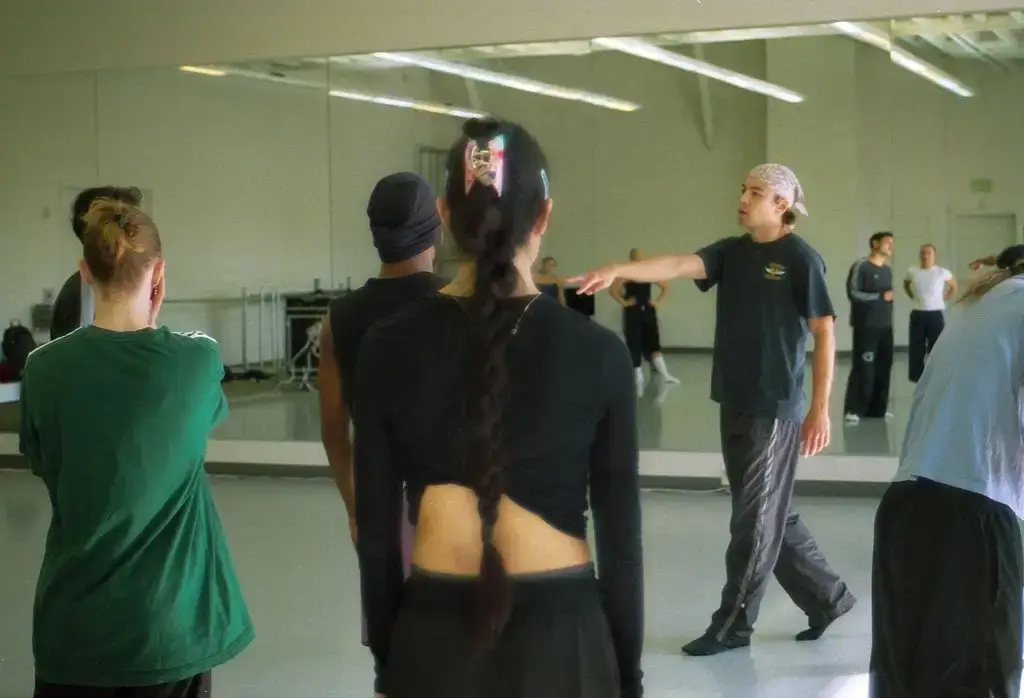
Akira Uchida: I like to think about the bigger picture when I'm creating movement and how it interacts with the other elements at play: sound, lighting, environment, viewer, clothing, camera. I am really drawn to subtlety in the smallest details and I think in a lot of ways this is where I get to really shine as an artist. A lot of it has to do with leaning into my own sensitivity as a person and noticing how the smallest edit or detail can impact the entirety of a moment. Sometimes, finding the right angle of a head turn, an added shift into a hip, an opening of a side rib or a cue for using the eyes can bring everything together. This is very exciting to me.
In the initial stages, I'm much more interested in the "how" and "why" behind the movement, rather than the "what". This allows me and the dancers to approach the movement from an internal place, leaning into an experience or a state of being rather than trying on the shell of the movement. That being said, the approach varies a lot depending on the project. For longer processes that are more research-oriented, I have a methodology I've developed that I share with the dancers to help them understand how to embody my movement vocabulary. This movement research has helped me develop a recognizable style for my work, which permeates across all projects.
What are your main sources of inspiration?
Akira Uchida: I'm really drawn to the blending of genres and combining elements that wouldn't normally be associated with one another. I find there is something daunting and yet completely entrancing about living outside of the prescribed box of a genre to bring something new forth. In parallel to this, I try to draw my inspiration from sources outside of dance, whenever possible. I'm very inspired by other art forms and the thinking behind how something was made. I then like to extract those concepts and to apply them to a dance context. I've always been fascinated by design, and reading a couple books about its principles had a significant impact on my work, one of them being The Shape of Design by Frank Chimero. I also recently have been learning to DJ, and have started to incorporate mixing into the sound design process for my live work. I didn't realize how much the mixing process would influence how I think about composition and how a section or idea can simultaneously set up the next.
What role do music and sound play in your performances? In your creative process, does the music come first, or is it composed specifically for the piece later?
Akira Uchida: I see sound and movement as similar mediums in that they allow me to access forms of expression that go beyond anything I could ever articulate through words. Though I find language fascinating, words have never been my preferred way to express myself and so I'm more drawn to this type of abstract emotional expression. I've always been a huge lover of music, particularly electronic music and the intricacies of its production, which have inevitably influenced my work over the years. At first, it was just something I enjoyed listening to until I eventually realized it was something I could use to choreograph as well. Now, it's become a huge part of my work and something people associate me with.
When it comes to my process, I've worked both ways: sometimes I begin creating movement and choose the music afterwards, while other times I start with the music and work alongside it throughout the process. I see the music not quite as a script, but something looser that I can be working alongside throughout the process. Regardless of where I start, I think it's important for the elements of sound and movement to feel enmeshed and intentional in how they interact. Even when the movement isn't directly synchronized with the music, its tone and atmosphere inevitably influence how I approach the choreography.
Improvisation, structure and dream stages
How do you balance improvisation and strict structure when working with dancers?
Akira Uchida: Improvisation actually plays a huge part in my process, probably more than most people would imagine while watching my work. It's less about discovering new ideas while I'm in the room with the dancers, though that is always useful, but rather a way for me to guide the dancers to embody my movement language. Even within improvisation, I like to establish some structure as I think creativity flourishes most for me when there's a focused direction and a set of parameters to work within. When it comes to setting the work, a lot of the details are very defined and particular, but I always like to leave some space for the dancers' individuality and choices to show up. I like for the dancers to approach the movement from an informed place (with the improvisation work we've done) so they can then make choices within the structure, as opposed to simply trying on the form of the choreography at face value.
Is there a specific space or unusual setting where you dream of staging your work?
Akira Uchida: I'm really drawn to outdoor performance spaces. I've performed at a few dance festivals where a river is the backdrop and these have been some of my most precious performance experiences. Jacob's Pillow is definitely on the bucket list for this reason. I'm also drawn to architectural spaces that have been thoughtfully designed for gathering or experiencing art. I think these types of spaces lend themselves to dance performances in unexpected but compelling ways. One of my dance films was shot at the Clyfford Still Museum in Denver. It was a magical day being in the museum space surrounded by the beauty of both the architecture and Clyfford Still's collection while filming. Watching the dancers made me think a lot about the relationship between the movement and the paintings, and how these interacted with the architecture. This type of synergy between multiple creative elements excites me. It would be a dream to present a live work in a similar setting one day.
Working with Ravyn Lenae and what comes next
How does your process change when collaborating with artists from other disciplines?
Akira Uchida: When it's the right creative match, I believe a good collaboration can really elevate a project and bring it to a place that's much greater than the sum of its parts. I love that collaboration offers a unique opportunity to learn about and discover another artist's inner creative world. Often, these experiences open me up to new ways of thinking and can even reveal psychological barriers or limiting beliefs I've held onto within my own process. I'd say the core elements of my process are essentially the same, but my choices will inevitably be more informed by my collaborators' work, ideas, and perspectives. I worked with Ravyn Lenae this year to develop the movement across the entire campaign for her new album Blue Island. We spent many hours in the studio discovering movements that felt true to her natural impulses as a performer, while also finding ways to push beyond her comfort zone, as this was her first time working with choreography. We had many conversations about her inspirations, both sonically and aesthetically, and these were some of my favourite moments in rehearsal. I wanted to deeply understand the growth and expansion this new era represents for her in order to develop a movement language that felt authentic to this moment in her artistry.
What are you working on right now, and what are your next steps?
Akira Uchida: I recently premiered a new work with Northwest Dance Project in Portland, OR. As we move toward the end of the year, I'm excited to dedicate some time to researching and developing my next personal project: a dance film. Stay tuned x
Lorenzo de' Nobili
Music Editor
Lorenzo de’ Nobili is a sound designer and composer driven by a deep passion for urban culture and its evolving aesthetics. His work explores the intersection of music, fashion and sport, blending contemporary sounds with strong visual identities. Alongside his research in urban culture, he collaborates with contemporary dance artists, creating immersive sonic experiences that connect movement, space and emotion.
LinkedIn@sereno________________________Share this editorial