
What can we do with a work of art besides looking at it? Inhabit it, move through it, even use it.
When art becomes part of everyday life, new ways of engaging with it emerge alongside observation and contemplation. This opens up a conception of art that extends beyond its purely aesthetic dimension. Such a perspective offers a starting point for a deeper understanding of Costantino Nivola's work.
Triennale Milano presents Costantino Nivola. Scolpire il vento, an exhibition curated by Cecilia Alemani with exhibition design by Alessandro Floris, on view from 11 November 2026 to 14 February 2027. More than two hundred works, organised into five chapters, trace Nivola's artistic practice, from his Sardinian roots to twentieth-century New York, through a visual language that brings together painting, sculpture, graphic arts, design and architecture. Throughout his career, the memory of his origins is not at odds with modernity, but in dialogue with it.
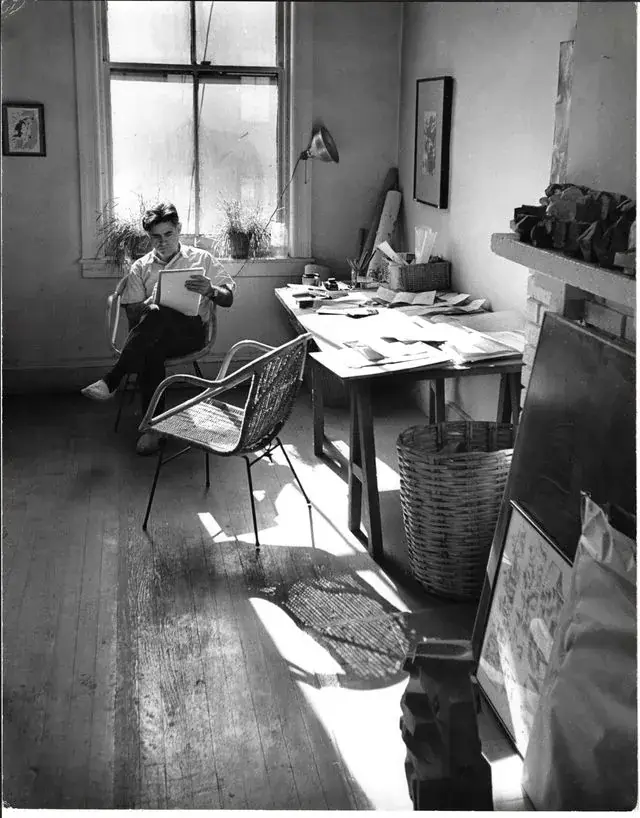
Roots within modernity
Costantino Nivola was born in 1911 in Orani, Sardinia, and grew up in a world shaped by tradition, everyday gestures and a close relationship with nature. In 1939, after the Fascist racial laws were introduced, he moved to New York with his wife, Ruth Guggenheim, who was of Jewish descent. His encounter with the American art scene does not erase his connection to his homeland. Nivola reinterprets his cultural heritage through a modern artistic language, weaving the memory of his native island into the experimentation of the twentieth century.
This connection with the past emerges most clearly in his representation of the human figure through essential and archetypal forms.
In his male figures, Nivola celebrates the dignity of manual labour, a theme deeply rooted in his personal experience. The project for the Monumento al muratore di Orani (1955), conceived as a tribute to his father's craft and to his fellow townspeople, marks the beginning of the Building Blocks series, a collection of anthropomorphic figures composed of geometric, interlocking concrete blocks.
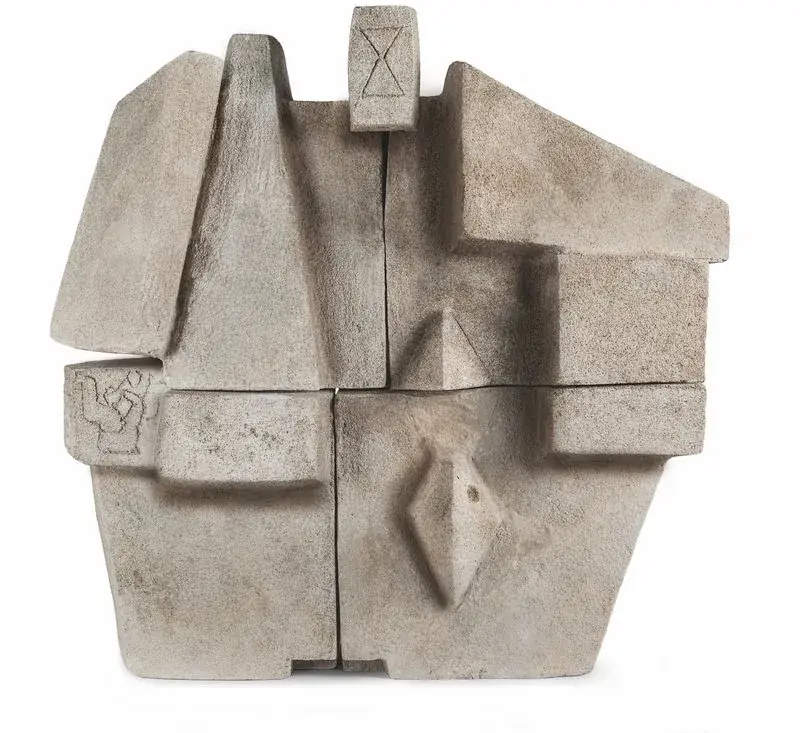
The decision to dedicate a monument to an ordinary worker suggests a conception of public memory that moves away from the celebration of great historical figures, granting monumental dignity to the gestures and trades of everyday life.
However, Nivola also rethinks the monument's form. He imagines sculptures on an architectural scale, as tall as buildings, in which the boundary between sculpture and architecture begins to dissolve. This ambition remained unrealised, yet it reveals his desire to transcend traditional distinctions between art forms.
In his female figures, the references to his cultural origins take on different meanings. The Grandi Madri, whose forms resemble ancient figurines from the Neolithic Mediterranean, evoke motherhood and the generative power of nature. In the Vedove sarde, by contrast, mourning becomes an expression of pride and independence. Through these two representations, Nivola revisits the symbols and memories of Mediterranean culture, translating them into a contemporary artistic language.
This continuous reworking of memory reveals an attempt to preserve a connection with nature and the fundamental experiences of human existence, while engaging with the transformations of modern society. This reflection also echoes some aspects of Jean-Jacques Rousseau's thinking on the relationship between nature and civilisation: not a literal return to a primitive state, but an exploration of what can be preserved of humanity's original condition within modernity.
When sculpture meets architecture
In 1946, in New York, Costantino Nivola meets Le Corbusier, one of the leading figures of the Modern Movement. A friendship develops between them, accompanied by a rich artistic exchange, fuelled by their shared interest in the dialogue between art and architecture and the role both can play in modern life.
While Le Corbusier, through his concept of the house as a "machine for living in", rethinks domestic space around the needs of its inhabitants, Nivola explores the possibilities of sculpture within communal spaces. Two distinct perspectives, united by a desire to redefine the relationship between human beings and their surroundings.
This exploration finds expression in Nivola's first major sculptural commission: a relief measuring twenty-three metres in length, created in 1954 for the Olivetti showroom in New York. Using the technique of sandcasting, which employs sand as a mould to create sculpted surfaces, Nivola produces a monumental work integrated into the interior designed by the architectural firm BBPR. The sculpture does not merely complement the architecture but helps define the space itself.
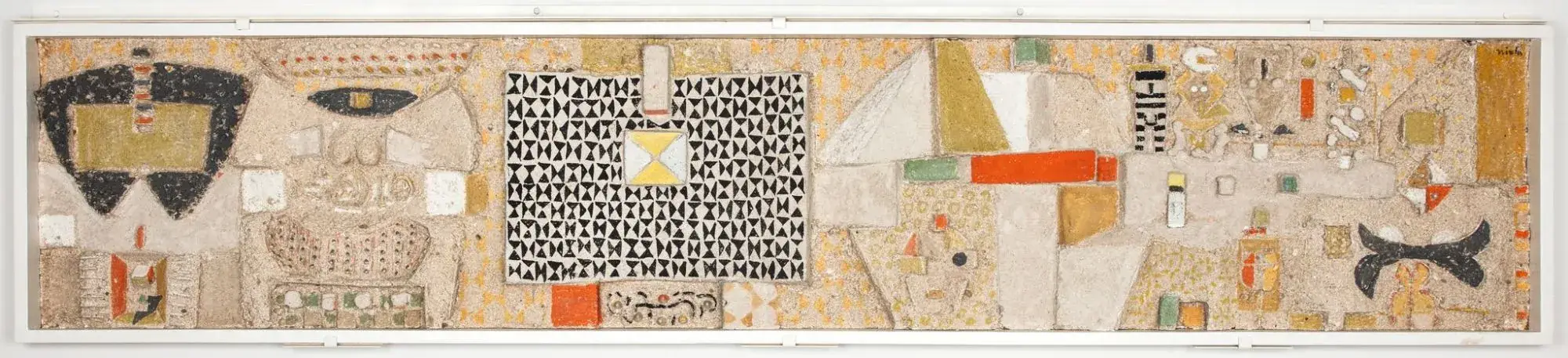
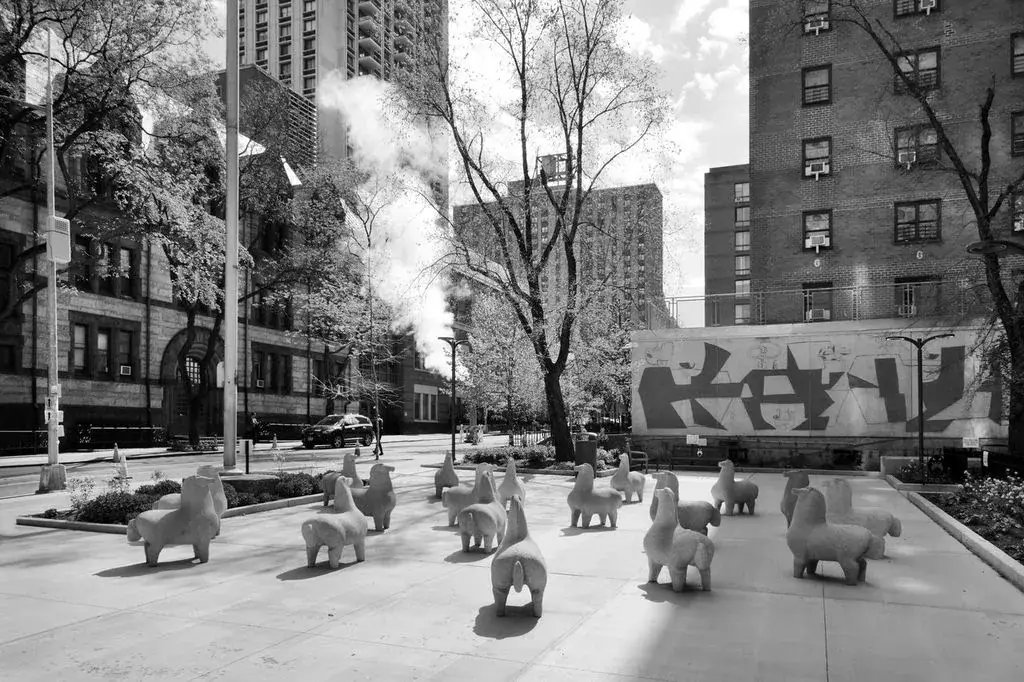
The relationship between the artwork and the public takes on an even more direct dimension at New York's Stephen Wise Recreation Area, a public playground designed in collaboration with architect Richard Stein, for which Nivola creates eighteen small concrete horses between 1963 and 1964. Here, sculpture ceases to be an untouchable object and becomes part of children's play, integrating the artistic experience into everyday life.
Cecilia Alemani on Nivola: art belongs to life
Nivola believes in an art that does not remain distant from people. We discussed this vision with Cecilia Alemani, the exhibition's curator.
What is the most contemporary aspect of Nivola's artistic research?
Cecilia Alemani: I think it is, in a sense, his approach to public space through the major commissions he carried out in the United States using the technique of sandcasting. These interventions help humanise space: large buildings, such as public schools or federal buildings, which can seem distant, almost alien, become more human and accessible to the communities that use them.
While preparing the exhibition, was there an aspect of Nivola's work that particularly surprised you or that you rediscovered?
Cecilia Alemani: Quite a few, actually. What helped me bring everything full circle was his relationship with space, the countryside and green spaces, particularly the garden in Springs, in the Hamptons, where he lived. It was a tangible expression of his approach to art and everyday life, reflecting the idea that there was no distinction between art and life. The garden became a space for welcoming a community of artists, colleagues, and friends, who would gather to chat, eat, and probably discuss artistic creativity. It is an aspect of Nivola that I was unfamiliar with and that is usually associated with other artists, but not with him.
Perhaps this is where the deeper meaning of "sculpting the wind" lies: giving shape not only to matter, but also to space and the relationships that come to life within it.
Dates: 11 November 2026 to 14 February 2027
Venue: Triennale Milano, Viale Alemagna 6, Milan

Magda Paladini
Journalist
Milan-based fashion journalist. I meet people, observe, ask questions and tell stories.
LinkedIn@magda_paladiniShare this editorial